

Sole trader bookkeeping services: what support can take off your plate?
Updated: 6 days ago
What if the books didn’t have to wait until the end of a long working day? Paid work, invoices, receipts and everyday admin all compete for your attention. Sole trader bookkeeping services can take regular record-keeping off your plate, but it’s not always clear what bookkeeping includes or how it differs from tax and accountancy support.
You might be weighing up whether to keep managing everything yourself, move your records into digital software or get help with Making Tax Digital for Income Tax. I’m Julie Holland, and I provide personal bookkeeping support through Blu Bookkeeping, including transaction recording, reconciliations and clear financial reports. I work remotely with sole traders in Reading and West Berkshire from Purley-on-Thames.
This guide explains what ongoing bookkeeping support can cover, what it doesn’t automatically include, and how it compares with keeping your own books. You’ll also find practical points to consider when choosing a routine for digital records and MTD.
Table of Contents
Why sole trader bookkeeping services can make business finances clearer
Invoices need sending, expenses need recording and client work still has to get done. If bookkeeping keeps slipping to the end of the day, it can become harder to remember what’s been paid, what’s still due and which receipts need filing. Regular support can stop small admin jobs turning into one large catch-up task.
Sole trader bookkeeping services provide regular help recording and organising business transactions. This usually means keeping a clear record of money coming in and going out, then checking the entries against account information. The aim is an organised picture of business activity, not a promise of tax savings.
Bookkeeping focuses on recording and checking transactions. It’s different from wider accounting work or tax advice, which may involve interpreting figures or advising on tax matters. The Bookkeeping overview explains the practice and its role in keeping financial records. Knowing the distinction helps you understand what regular record-keeping support can do and where its role ends.
What can organised bookkeeping help a sole trader see?
When income and expenses are recorded consistently, you can review what the business has earned and spent over a period. You can also spot items that need attention, such as an expense without a receipt or a client invoice that still appears unpaid. Clear records make it easier to follow the trail behind the figures instead of relying on memory.
A reconciliation is a comparison between what’s recorded in the bookkeeping and information shown in an account, such as a bank statement. For example, a client’s invoice payment can be matched to the corresponding bank entry. If the amount or date doesn’t match, that’s a prompt to investigate before treating the records as complete.
Bookkeeping can’t tell you everything about the future of your business, but it gives you a more dependable view of what has happened. That can make routine tasks, such as reviewing unpaid invoices or checking a run of expenses, feel less like guesswork.
When can bookkeeping become harder to manage alone?
There isn’t one point when every sole trader needs help. A simple set-up with a steady flow of transactions may be manageable with a regular routine. More invoices, frequent expenses or irregular income can make it harder to keep records up to date alongside paid work.
Records can also become scattered across a bank account, email inbox, paper receipts and a spreadsheet. Then it takes longer to work out what has already been recorded and what still needs attention. A quick check can turn into a search through several places.
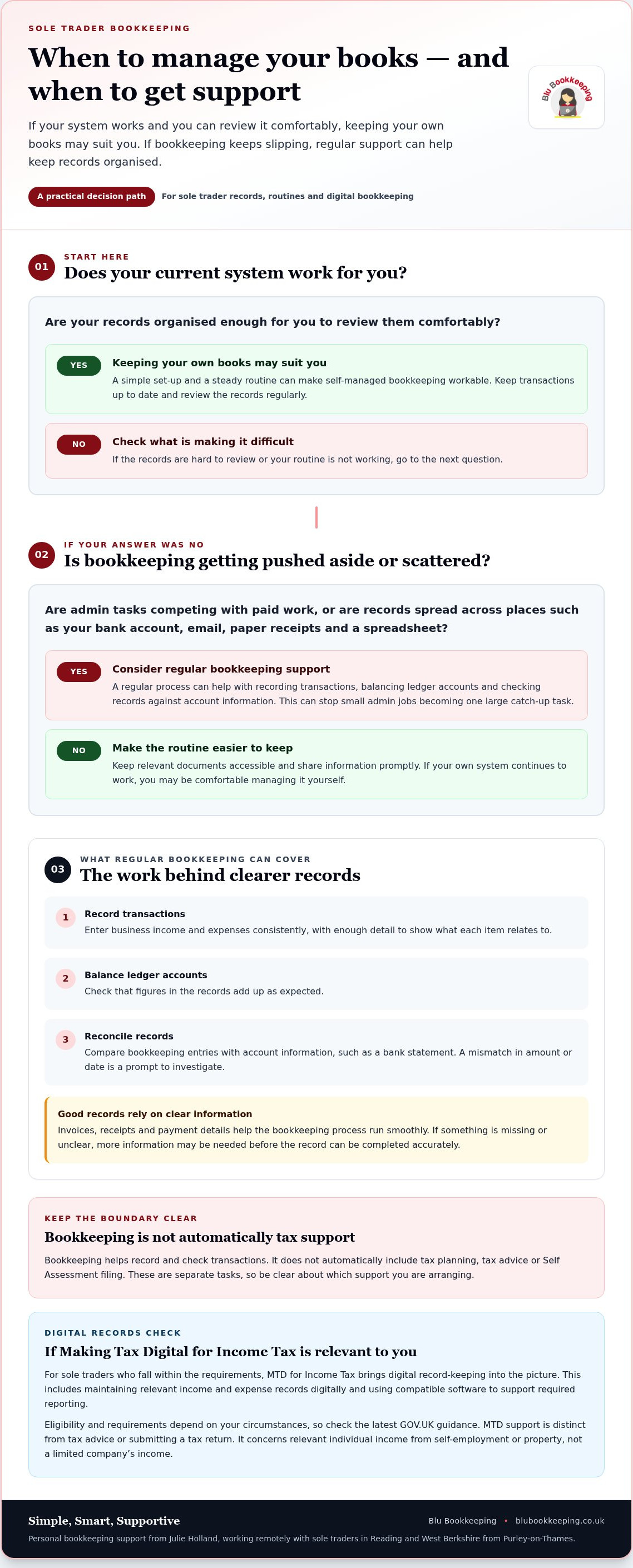
If your current system works and you can review it comfortably, keeping your own books may suit you. If bookkeeping repeatedly gets pushed aside, regular sole trader bookkeeping services can provide a steady process for recording transactions, balancing ledgers and checking records. The useful question isn’t whether you should do everything yourself, but which approach helps you keep a clear, workable picture of your business.
What sole trader bookkeeping services cover, and where the work ends
Bookkeeping support keeps a sole trader’s financial records organised. It can include recording transactions, balancing ledger accounts and reconciling entries with account information. The aim is to make the records easier to review and understand, not to promise a particular tax result.
The routine work behind clear business records
Each business transaction needs to be entered consistently, with enough detail to show what it relates to. A sale, supplier cost or other business expense should be recorded in the appropriate place, rather than left in an inbox or mixed in with personal spending. Regular records build a clearer picture of income and expenses over time.
Ledger balancing checks that figures in the records add up as expected. Reconciliation compares those records with account information, helping to identify missing or mismatched entries. These checks rely on clear information, such as invoices, receipts and payment details. If something is missing or unclear, you may need to provide more information before the record can be completed accurately.
Consistent records give you something useful to review: what has been recorded, what may need attention and how business activity has changed. The records are only as useful as the information behind them, so keeping relevant documents accessible and sharing details promptly helps the bookkeeping process run smoothly.
How bookkeeping relates to Making Tax Digital
Making Tax Digital (MTD) for Income Tax brings digital record-keeping into the picture for sole traders who fall within the requirements. The bookkeeping tasks include maintaining relevant income and expense records digitally and using compatible software to support the required reporting. Eligibility and requirements depend on your circumstances, so check the latest GOV.UK guidance on Making Tax Digital for Income Tax.
MTD support can help with digital records and the bookkeeping steps involved. It’s distinct from tax advice or submitting a tax return. MTD for Income Tax concerns relevant individual income from self-employment or property. It doesn’t apply to a limited company’s income, so sole trader and limited company bookkeeping need to be considered separately.
Bookkeeping doesn’t automatically include tax planning, tax advice or Self Assessment filing. These are separate tasks, so it’s helpful to be clear about which support you’re arranging. My sole trader bookkeeping services focus on practical record-keeping, including transaction recording, ledger balancing and reconciliations. That way, you know what the bookkeeping covers and where other work begins.
Manage bookkeeping yourself or use regular sole trader support?
There’s no single right answer. If your transactions are manageable and you can keep records current, doing your own bookkeeping may suit you well. If admin regularly gets pushed aside, or you spend time untangling entries, regular help may make the routine easier to maintain.
Area
Manage it yourself
Use regular support
Time
You set aside time to record and check transactions.
Some recurring record-keeping work is handled for you.
Routine
You choose when and how often to update your records.
A regular process helps keep the records moving.
Record visibility
You can review what you’ve entered and spot items to follow up.
Organised records can be easier to review as your business activity changes.
Responsibility
You provide and maintain your business information.
You still provide accurate information, while bookkeeping tasks receive support.
When keeping your own records may work well
Self-managed records can feel straightforward if you have a manageable flow of transactions and enough time to keep them up to date. You may prefer to stay close to each entry and know where your business information is stored. The key is whether your routine fits around your work instead of becoming an unwelcome catch-up job.
Whichever approach you choose, you remain responsible for providing accurate information about your business. Bookkeeping support can help organise and check records, but it doesn’t remove your role in supplying the details behind them.
When regular bookkeeping support may ease the workload
A growing number of transactions, uneven income or limited time for admin can make it harder to keep a steady rhythm. If invoices and expense records build up, it may take longer to work out what’s already been recorded. Regular support gives these tasks a consistent place in your working routine, making records easier to review when you need them.
Bookkeeping is practical work focused on recording and checking financial information. For a UK sole trader, deciding whether to manage it yourself or use regular support comes down to the time and routine that suit your business. Either approach relies on accurate information, and bookkeeping support doesn’t guarantee compliance or a particular financial result.
If you’re comparing self-managed records with ongoing help, I can talk through how Blu Bookkeeping’s sole trader support could fit your bookkeeping routine.
How to choose sole trader bookkeeping support that fits
The right support starts with your day-to-day workload, not a one-size-fits-all package. Before choosing, jot down the bookkeeping jobs that keep getting postponed or take longer than you’d like. That list can help you decide what to hand over, how often you need support and what you’d prefer to keep doing yourself.
Pin down the tasks. Note whether you need help recording transactions, balancing ledger records or checking account entries through reconciliations. Be specific about recurring jobs that take your time. This keeps the conversation focused on bookkeeping, rather than assuming it includes tax planning, tax advice or tax-return filing.
Choose a workable frequency. Think about how often your records need attention to stay useful. A steady routine may suit a consistent flow of activity, whilst busier or more changeable periods may call for a different rhythm. Aim for an arrangement that fits your business instead of adding another demanding deadline.
Consider your digital records. Decide whether you want help maintaining records in cloud bookkeeping software or practical support with digital record-keeping for Making Tax Digital. The tools should support a clear process, not leave you wondering where to enter information or how to share it.
Agree how you’ll communicate. A good working routine makes clear what information you provide, how it’s shared and which bookkeeping tasks are handled for you. Complete, timely information helps keep records accurate and makes it easier to follow up on anything that needs clarification.
Start with the bookkeeping tasks you want help with
Ask yourself which jobs recur, which tend to build up and which you’re comfortable handling. Perhaps you want someone to record transactions regularly but prefer to keep your own invoices organised. Or perhaps maintaining digital records is the part you’d most like support with. Being clear about this helps shape a useful service without blurring bookkeeping with other financial work.
Agree a practical way of working together
Clear responsibilities matter on both sides. You provide complete business information, and you should understand which bookkeeping tasks are being taken care of and how often. I work with fixed monthly fees, so the fee is agreed as a regular amount. A sensible arrangement also makes it clear how records and questions will be shared, so you know what to expect from the routine.
If you’d like to discuss a bookkeeping routine that suits your business, you can explore sole trader bookkeeping support with me at Blu Bookkeeping.
Sole trader bookkeeping with Blu Bookkeeping in Purley-on-Thames
Blu Bookkeeping is a personal bookkeeping service run by me, Julie Holland, from Purley-on-Thames. I support sole traders remotely across Reading and West Berkshire, helping keep day-to-day records organised. You deal with me directly, so we can talk plainly about the bookkeeping tasks taking up your time and the kind of routine that would suit your business.
A simple, supportive way to keep records in hand
My sole trader bookkeeping services focus on the practical work behind clear records: recording transactions, balancing ledgers and reconciling entries with account information. I help keep the bookkeeping process moving, while you provide the business information needed to make the records complete and understandable.
Cloud bookkeeping gives you a digital place for business records. Clear financial reports help you review what has been recorded and understand your business activity. Rather than piecing figures together from separate notes and documents, you can look at the information in a more organised form.
I know bookkeeping needs to fit around the way you actually work. I explain what I’m doing in everyday language and help you understand the records, without making you feel you should already know accounting terms. My approach is Simple, Smart and Supportive, with fixed monthly fees agreed as a regular amount. Support with digital record-keeping or Making Tax Digital is practical bookkeeping help, not tax advice.
The right arrangement makes responsibilities clear. We can look at the bookkeeping tasks you want help with and the information needed to keep those records in order. That gives us a practical starting point, whether you’re setting up a routine or looking for support with ongoing bookkeeping.
A straightforward next step for sole traders
You don’t need to have everything neatly sorted before we talk. It’s enough to have a sense of which jobs are taking the most time, perhaps recording transactions, keeping digital records or checking whether the bookkeeping is up to date. We can discuss the support that may fit and the information you would provide as part of the arrangement.
If you’re a sole trader in Reading or West Berkshire and would like to talk through your bookkeeping, you’re welcome to book a free discovery call with Julie. It’s a relaxed chance to discuss what you’d like to make easier and whether my support feels like a good fit.
Choose a bookkeeping routine that can grow with you
Your bookkeeping routine can change as your business does. The approach that feels manageable now may need adjusting as your workload shifts, so review what’s working and what isn’t. A small change to your routine can be a useful next step, even if you’re not ready to hand any tasks over.
You don’t need to decide every detail at once. Start with what would make your working week more manageable, then choose an approach that suits you today. Clear, organised records are something you can build towards at a pace that feels right.
Frequently Asked Questions
Is it worth paying for sole trader bookkeeping services?
It may be, especially if bookkeeping regularly interrupts your working day. Look back over a typical month and note how much time goes on chasing missing details, catching up or working out what needs attention. Then consider whether that time would be better spent elsewhere. If your records are simple and you keep them current, doing the bookkeeping yourself may still be the right choice.
How much do sole trader bookkeeping services cost?
The fee depends on the work involved and the level of support you need. Before discussing an arrangement, make a note of roughly how much activity you handle and whether your records are already organised digitally. That gives us a clearer basis for discussing the scope of the work. At Blu Bookkeeping, I use fixed monthly fees, so the agreed amount is regular and based on the support arranged.
Can I use a bookkeeper without hiring an accountant?
Yes. You can arrange bookkeeping on its own rather than choosing a wider accountancy package. This can suit you if your immediate priority is having your business records maintained. Before getting started, agree what period of records the work will cover and how queries about unclear entries will be handled. That helps set expectations without bundling in work you don’t need.
Do I need to change how I work to use a bookkeeper?
No, you don’t necessarily need to change your whole working routine. You might keep sending customer invoices and storing receipts as you do now, then agree how those details will be shared for bookkeeping. You can also discuss which jobs you’d like to continue handling yourself. The aim is to make the arrangement fit your existing way of working, rather than require a particular software set-up.
When does Making Tax Digital for Income Tax apply to sole traders?
There isn’t one answer for every sole trader. Eligibility and start dates depend on the current HMRC rules and the income measure that applies to your circumstances. Use the latest GOV.UK guidance on Making Tax Digital for Income Tax to check what applies before making plans. Avoid relying on older articles, and don’t apply sole trader rules to limited company income.
Can a sole trader use bookkeeping support when starting a business?
Yes. A new sole trader can arrange support from the start, although there’s no requirement to buy a bookkeeping service. Early support can help you decide how to keep your first business records distinct from personal paperwork and which recurring jobs you want help with. You can begin with the tasks that suit your start-up routine, then review the arrangement as your business activity develops.


Comments